

Why the Netherlands Must Hold the Line on ASML

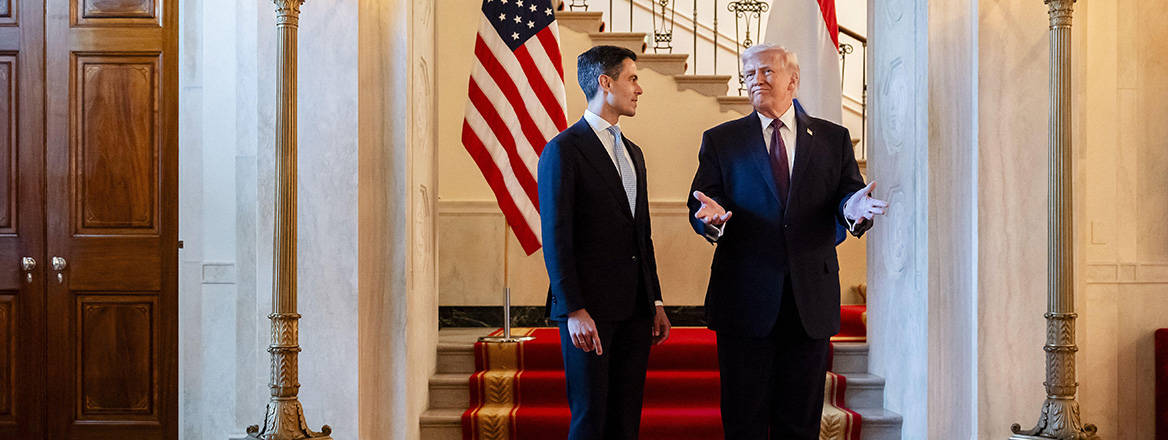
If the Netherlands agrees to US export controls, it must be mindful of its vulnerability to retaliatory measures from Beijing.
Over recent decades, Dutch technology giant ASML has become a vital node in the global economy. The company is the market leader for the photolithography systems used for semiconductor manufacturing and the world’s only manufacturer of the much-coveted extreme ultraviolet (EUV) machines. Without ASML, industries depending on advanced chips, such as AI, telecommunications and aerospace, would be severely hindered. The firm is expanding its manufacturing capacity but is still expected to struggle to meet the ever-growing demand for its products.
This technological relevance has also placed ASML at the centre of the ongoing US–China tech race. After years of American pressure, the Netherlands has repeatedly restricted exports of semiconductor manufacturing equipment to China. However, the current Dutch government has recently pushed back against the pending US MATCH Act designed to limit ASML’s China exports even further, with Dutch Prime Minister Rob Jetten raising concerns directly with US President Donald Trump.
The Case Against Further Export Restrictions
While Washington’s anxiety over Beijing’s semiconductor advances is understandable, the Netherlands has good reasons to oppose further export restrictions.
Restricting lithography exports to China might slow down advanced Chinese chip production in the short term. However, this could prove a short-sighted strategy. Chinese lithography technology is evolving, but its deep ultraviolet (DUV) machines remain roughly a decade behind ASML’s most advanced equipment. Further restrictions risk strengthening Beijing’s motivation to develop indigenous alternatives at scale, accelerating investments into the domestic Chinese lithography and chip industry.
The US wishes to curb China’s high-tech and AI industries, but Europe has an interest in maintaining this rare economic and geopolitical chokepoint
Proponents of export restrictions warn that ASML sales to China could enable technological leapfrogs, a concern echoed by US lawmakers supporting the MATCH Act. Historically, Beijing has continuously absorbed foreign technologies while developing domestic alternatives. Notable examples of this are China’s high-speed rail market, where Beijing used technology transfers from Germany, France, Japan and Canada to boost competitive domestic alternatives, and Beijing’s vibrant electric vehicle (EV) market, which similarly benefitted from early partnerships with European auto manufacturers.
The Barriers to Chinese Self-Sufficiency
It would therefore be naïve to assume that access to ASML equipment would fully dissuade China from expanding its own lithography capabilities. After all, Beijing understands the value of economic and technological self-sufficiency well.
Yet, concerns over China’s ability to leapfrog this technology should not be overstated. Beijing’s determination for indigenisation does not mean that it can instantly replicate ASML’s advanced machines. Lithography machines are difficult to fully reverse engineer. ASML sits atop a complex and sophisticated ecosystem of highly specialised technologies and suppliers that took decades to develop and fine-tune. In 2025, the Dutch company sourced from 5,100 suppliers and spent an impressive €4.7 billion on R&D to continue developing the next generation of lithography technology. Its improvement cycle and the continuous improvement of speed and accuracy of its machines add additional challenges for competitors that not only have to catch up, but also keep pace with future upgrades. Jos Benschop, ASML’s executive vice president of technology, once described one of its machines as ‘the most complex machine built by mankind’.

The complexity of lithography technology means that access to foreign equipment on its own may not yield the same benefits as in other industries. Policy research suggests that China has struggled more to close technological gaps in industries with long learning cycles and a reliance on tacit knowledge. For instance, despite decades of access to advanced British and Russian military jet engines, China has historically struggled to develop and produce competitive indigenous military jet engines. Similarly, China continues to depend on foreign suppliers of high-end precision machine tools used in manufacturing despite having years of investment.
ASML as a Source of European Leverage
This dependency on ASML technology has made it a key chokepoint in the US-China AI race but also made it one of Europe’s most important sources of technological and economic power. The firm is the EU’s most valuable listed company and stands out on a continent struggling to compete with the high-tech industries of China and the US. Much of its revenue comes from China, which is forecast to account for 20% of its total revenue in 2026, primarily through sales of less-advanced lithography tools.
While Europe has legitimate security concerns over China’s technological rise, its interests do not necessarily align with Washington’s. The US wishes to curb China’s high-tech and AI industries, but Europe has an interest in maintaining this rare economic and geopolitical chokepoint. For as long as Beijing remains interested in accessing ASML’s lithography equipment, the Hague and Brussels have a dependency to leverage in their political and economic relationships with China – including during the ongoing EU–China trade negotiations and beyond.

ASML’s specialised supplier ecosystem is an asset, but it is not immune to global supply chain risks. If the Netherlands allows the company and its products to become tools within Washington’s China policy, it must be mindful of its vulnerability to retaliatory measures. Beijing’s recent sanctioning of Sindlhauser Materials, a key ASML supplier, is a clear example of its dependency on Chinese critical mineral supply chains and shows that export control standoffs can have severe commercial consequences. The impact has been significant, prompting the EU to negotiate sanction reliefs with China. Beijing has proposed lifting these restrictions in exchange for EU sanctions relief for Yusha Group, a Chinese textile firm accused of supplying European technology to Russia. As part of this agreement, however, Yusha would refrain from exporting banned products to Russia military-linked buyers. This engagement underlines the importance Beijing attaches to ASML’s supply chain and the leverage it brings in EU-China relations.
The Dutch government should be cautious in how it proceeds when managing ASML’s export licences. It should continue coordinating with Washington to safeguard critical technologies, but also resist measures that would undermine one of Europe’s rare technological chokepoints. Preserving ASML’s access to the Chinese market would benefit the European lithography industry and grant the Netherlands and the EU much-needed economic leverage with which to safeguard their own strategic interests.
© Lasse de Graaf, 2026, published by RUSI with permission of the author.
The views expressed in this Commentary are the author's, and do not represent those of RUSI or any other institution.
For terms of use, see Website Terms and Conditions of Use.
Have an idea for a Commentary you'd like to write for us? Send a short pitch to commentaries@rusi.org and we'll get back to you if it fits into our research interests. View full guidelines for contributors.
WRITTEN BY
Lasse de Graaf
Guest Contributor


- Jim McLeanMedia Relations Manager+44 (0)7917 373 069JimMc@rusi.org