

What Do Brazil’s Elections Mean for its Foreign Policy?

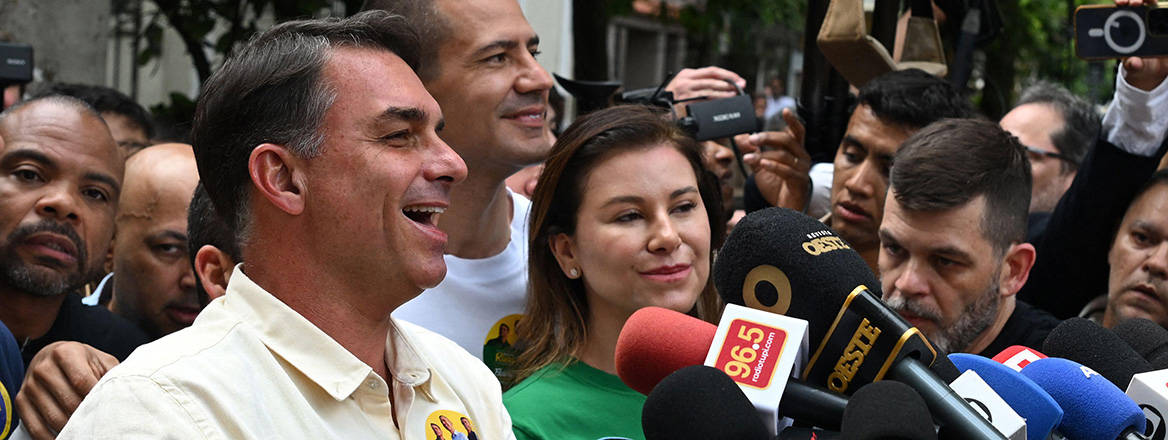
Whether Lula or Flávio Bolsonaro wins Brazil’s presidential run-off, a right-leaning Congress and pressure from China, the US and Europe will constrain its foreign policy.
‘Brazil is not for beginners’. The mantra coined by Brazilian songwriter Tom Jobim in the 1960s is more valid than ever. As we approach the second round of the 2026 presidential election, everyone – from financial analysts in Faria Lima (the financial heart of Brazil) to the residents of the small town of Ubaíra (home to large rare-earth deposits) – is waiting for Brazil’s electoral results. Whatever the outcome of the ballot, it promises deep changes to their lives.
Two Projects, Shared Pragmatism
At the centre, there are two political, economic, institutional and social projects starkly different at first glance. On one side, there is President Luiz Inácio Lula da Silva, turning 81 years old and running for his fourth term. Lula is an experienced and skilful politician, having co-founded the Workers’ Party (PT) in 1980. Before being elected president in 2002, Lula was defeated in the 1989, 1994 and 1998 elections. Lula’s reputation is based on his capacity to build pragmatic alliances and reinvent himself while being able to communicate with the wide spectrum of Brazilian society. His administrations have been embraced by progressive sectors who advocated for economic development together with inequality reduction and advocacy for minority rights. Lula’s foreign policy sought to diversify partnerships and strengthen regional ties through regional organisations, such as the establishment of UNASUR (Union of South American Nations), working together with Hugo Chávez and funding infrastructure projects in Venezuela and Cuba through the Brazilian Development Bank (BNDES).
On the other side, there is Flávio Bolsonaro, 45 years old. He was four times elected a legislative representative in Rio de Janeiro and was elected a senator in 2018, being the fourth most voted in the country. Similarly to his father, former president Jair Bolsonaro, Flávio had numerous partisan affiliations. He was affiliated to the Partido Progressista (PP) for most of his legislative years. PP is a traditional and centre-right party that was in coalition with PT from 2003 to 2016, being directly involved with corruption scandals. Flávio left PP in 2016 for the Partido Social Cristão, when he ran for Mayor of Rio de Janeiro. In 2018, he affiliated to the Partido Social Liberal for his election to the Senate. After failing to establish their own party, Flávio and Jair Bolsonaro had short periods in Republicanos (2020-21), and Patriota (2021), until they joined the Partido Liberal (PL) in 2021. In similar terms to PP, PL used to be a centre-right party from the centrão (‘big centre’) and joined PT’s administrations’ supporting base. Brazil has been known for its ‘coalition presidentialism’, where incumbents need to have legislative support to be able to govern. This supporting base represents a group of ‘physiologic’ parties, as they exchange their support to incumbents for larger budget allocations and strategic positions in ministries.
The partisan configuration in 2027 reveals a divided country that has, since 2018, progressively leaned toward a right-wing conservative agenda – or, at the very least, distanced itself from the left progressive
Therefore, there is an interesting common element between Lula and Flávio: their political pragmatism. Lula’s administration made coalitions with the big centre whereas Flávio and his father have been part of the big centre for many years of their political careers. Nevertheless, their differences seem to count much more to the markets and other foreign leaders, such as the US president, Donald Trump. Flávio’s leading results in the first round of the 2026 elections was celebrated by Trump, describing results as ‘a very, very big victory. Amazing, actually’. In US case, a potential victory for Flavio would confirm a Brazilian closer alignment to the US foreign policy and a progress of the ‘Donroe Doctrine’ in Latin America. For markets, there was also a striking optimism: Ibovespa, Brazil’s benchmark stock index, had an increase of 7.7% on the following day and broke a historical record, surpassing 200,000 points. Governability can explain this market enthusiasm, which stem from what Flávio Bolsonaro’s potential victory means for Brazil, the region and the world.
A Stronger Right
PL (Flávio’s party) transformed itself in 2021 when it welcomed the Bolsonaro family to its ranks. From the centre, PL became the institutional representation of Bolsonarismo, turning to a far more conservative political agenda. The party had an impressive performance in the 2022 election, moving from 33 to 99 representatives in the Chamber of Deputies. In 2026, PL moved to 121 of 513 seats. In the Senate, they secured 28 of 81 seats, meaning the party alone now has almost a quarter of the Chamber of Deputies and a third of the Senate. As other right and centre-right parties declared support for Flávio Bolsonaro in this upcoming second round, his potential administration could benefit from majorities, allowing far more governability than Lula, with the latter risking facing a complete deadlock in his administration.
Supporting governability, there is favourable popular mood. As Lula seeks a fourth term, fatigue with PT’s political project progressively grows – a sentiment that traces its origin back to the 2013 protests against the cost of living. Lula’s administrations from 2003 to 2010 inherited economic stability after years of hyperinflation and internal and external debt. A strong economic performance produced by favourable commodity prices together with a thriving Chinese economy to consume them elevated Brazil’s status as an ‘emerging economy’. A new middle class was eager to occupy spaces and consume products that were once out of reach. This alignment of the stars gave Lula the political capital to elect his successor, Dilma Rousseff (2011–14).

However, Dilma Rousseff’s administration suffered from the worsening of Brazil’s economic performance. Poor economic results compounded by corruption scandals led to a disassociation between the country’s aspirations and its real performance, not only by society but also in international forums. Popular discontent was quickly channelled by emerging civil society organisations, such as Movimento Brasil Livre and Vem Pra Rua, which not only forged an anti-corruption movement, but also provided new political figures to the Brazilian right-wing landscape based on a direct antagonism to PT and Rousseff’s administration. She won the second round by a slim margin, securing a fragile second mandate that immediately suffered from the lack of legislative support. Rousseff did not complete her mandate, being impeached in 2016.
The ideological fracture deepened throughout the years. Lula was barred from running in 2018 following convictions that were later annulled. His political capital could not secure PT’s victory through Fernando Haddad either and Jair Bolsonaro won as an anti-system candidate. Once in power, he quickly built his legislative support and elevated the judiciary as his new nemesis. His mandate (2019–22) was marked by political clashes with the Supreme Federal Court and challenges to the electoral system. Internationally, Lula and Dilma sought to increase Brazil’s influence in the main international forums as the Global South’s leading voice by participating in UN peace operations (MINUSTAH in Haiti and UNIFIL in Lebanon), and engaging with the BRICS since 2006 to counterbalance Western institutions. By contrast, Bolsonaro’s government was marked by a retreat of Brazil’s participation in international organisations, direct alignment with the US (during Trump’s administration) and strong support for Israel. Therefore, the partisan configuration in 2027 reveals a divided country that has, since 2018, progressively leaned toward a right-wing conservative agenda – or, at the very least, distanced itself from the left progressive.


But the main question that lies ahead is: would a potential mandate from Flávio Bolsonaro differ significantly from his father’s? Or can Lula still pursue his agenda in the face of such an adverse governing framework in 2027? If Flávio wins, he will enjoy much more goodwill from markets and the legislative houses (Chamber of Deputies and Senate) for his projects. He is clear about seeking the annulment of his father’s 2025 judicial conviction for plotting a coup whilst allies foresee a pardoning for those involved in the invasion of Congress on 8 January 2023. Some experts raised concerns about the future of the judiciary’s independence as the Senate could impeach Supreme Court justices and PL now has a third of the house. Regionally, Flávio will also enjoy a much more favourable ideological environment, as most countries in South America are now led by right-wing governments.
International Constraints
Internationally, the scenario is more blurred. China is in direct technological, resource and trade competition with the US, especially in Latin America, becoming Brazil’s main trade partner in 2009. Recently, China has expanded its focus to mining, infrastructure and energy China’s MMG agreed to acquire Anglo American’s nickel operations in 2025, and China Nonferrous Metal Mining Group acquired Mineração Taboca for tin and niobium extraction. In terms of infrastructure, China’s CRRC in a consortium with a Brazilian company will build an intercity railway between São Paulo and Campinas. Therefore, reducing the Chinese influx of investments in favour of the US (especially in critical minerals) will be a tough task in case of a victory for Flávio. Likewise, an expansion of Chinese investment in case of Lula’s victory could also be quite difficult, as he will face the widest opposition to his government. The relationship with Europe will be marked by the implementation of the EU–Mercosur trade agreement and by how environmental protection is championed by the future administration, as deforestation is a non-trade barrier for the EU. With the US, organised crime and tariff negotiations might dominate bilateral dialogues. In 2025, Trump imposed 50% tariffs on several Brazilian exports alleging unbalanced trade and political persecution of Jair Bolsonaro. Although the US Supreme Court annulled Trump’s presidential order, tariffs returned in 2026 and both countries agreed to create a working group to negotiate a relief deal.
The strong dominance of right-wing parties in legislative houses and a potential reduction of judiciary counterweight will not stop the advance of a conservative agenda, regardless of who occupies the Alvorada Palace. If a Flávio victory might make legislative–executive relationships much less convoluted in comparison to a Lula victory, the expectation is that clashes with the judiciary will be the main source of tension. In any scenario, Brazil’s following years promise breathtaking events with local and global repercussions.
© RUSI, 2026.
The views expressed in this Commentary are the author's, and do not represent those of RUSI or any other institution.
For terms of use, see Website Terms and Conditions of Use.
Have an idea for a Commentary you'd like to write for us? Send a short pitch to commentaries@rusi.org and we'll get back to you if it fits into our research interests. View full guidelines for contributors.
WRITTEN BY
Dr Daniela Portella Sampaio
Senior Research Fellow - Latin America Security
International Security


- Jim McLeanMedia Relations Manager+44 (0)7917 373 069JimMc@rusi.org